
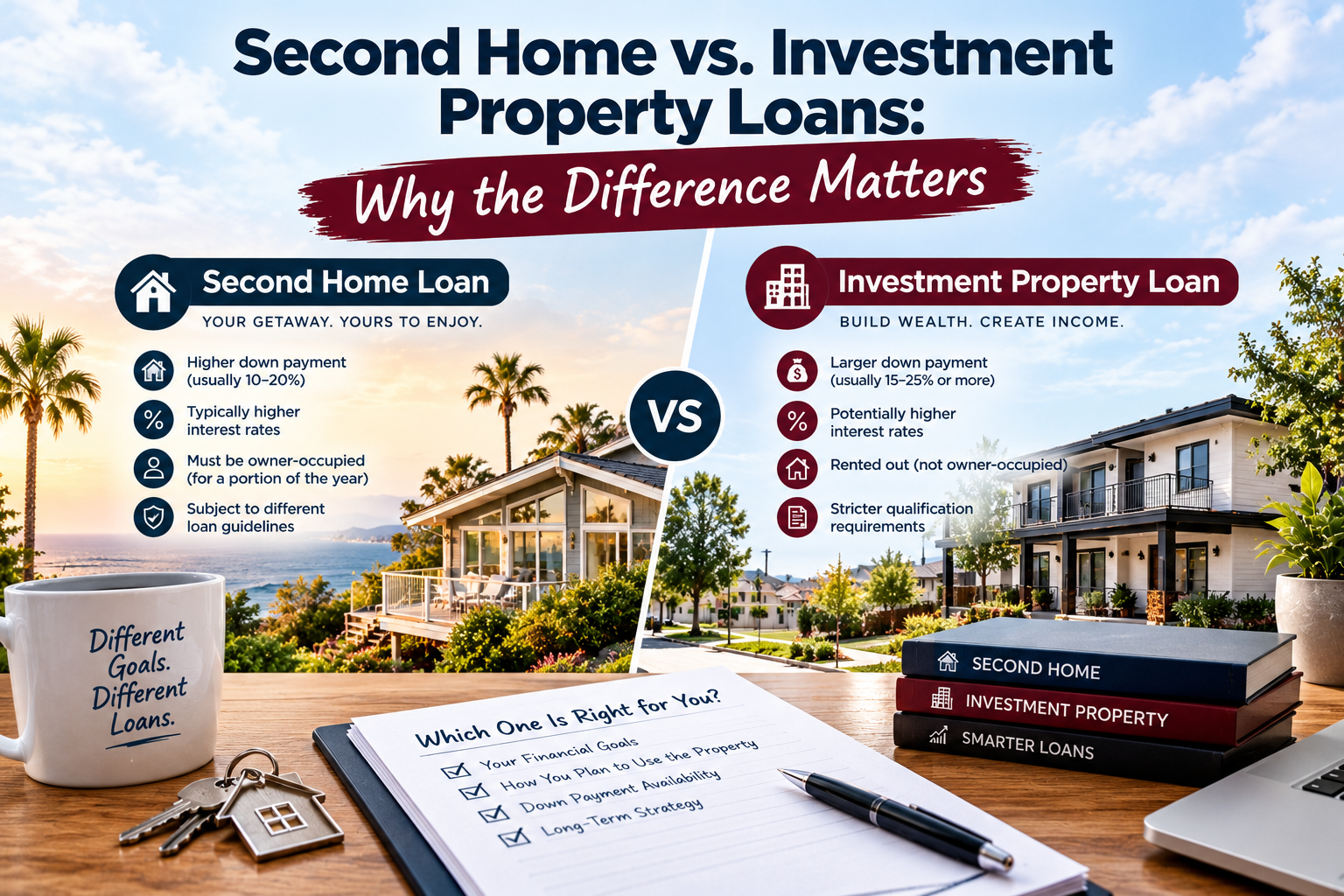

Second Home vs. Investment Property Loans: Why the Difference Matters
If you’re thinking about buying a place in coastal Orange County or San Diego, say a beach house in Newport Beach, a condo in La Jolla, or a getaway in Carlsbad, one question comes up early: is this a second home or an investment property? It sounds like a technicality, but lenders treat the two very differently, and the answer changes your down payment, your rate, your reserves, and how your income is counted.
It also matters for a more serious reason: getting the classification wrong on purpose is mortgage fraud. Here’s how lenders draw the line, what each option costs, and when a DSCR loan is the better fit anyway.
How Lenders Define a Second Home
A second home is a property you buy for your own personal use, in addition to your main residence. Under conventional guidelines, a second home generally has to meet these conditions:
- You occupy it for part of the year. It’s a place you actually use, whether that’s weekends, summers, or seasonal stays.
- It’s suitable for year-round living. A cabin with no heat or a seasonal-use-only structure usually doesn’t qualify.
- It’s a one-unit property. Duplexes and larger buildings are generally classified as investment properties when you don’t live in one of the units.
- You have exclusive control of it. It can’t be part of a timeshare, a rental pool, or an arrangement that requires you to rent it out or have a management company control it.
- It makes sense as a second home. Lenders generally expect it to be a reasonable distance from your primary residence, so a second “home” down the street from your main one looks less like a vacation property and more like something else.
Rental income from a second home can’t be used to help you qualify. Your income has to carry both mortgages.
How Lenders Define an Investment Property
An investment property is one you don’t plan to occupy as a residence. You’re buying it to earn rental income, to hold for appreciation, or both. Long-term rentals, short-term rentals where you’re primarily operating a rental business, and duplexes or multi-unit buildings you won’t live in all fall here.
Investment financing is more restrictive, but it has one advantage: because the property is expected to earn income, a lender can often count a portion of the projected rent, commonly around 75% of gross rent, toward your qualifying income.
Second Home vs. Investment Property at a Glance
| Second Home | Investment Property | |
|---|---|---|
| Minimum down payment (conventional) | 10% for a one-unit property | 15% for a one-unit property; 25% for 2–4 units |
| Typical required reserves | Around 2 months | Around 6 months |
| Interest rate | Typically modestly above a primary residence | Typically a step above second home pricing |
| Rental income counts toward qualifying | No | Yes, typically at about 75% of gross rent |
| Your personal use | Required | Not required |
| FHA or VA eligible | No | No |
| Both mortgage payments in your DTI | Yes | Yes (rental income can offset some of it) |
The Rate and Down Payment Differences
Down payment. Under standard conventional guidelines, a one-unit second home can be financed with as little as 10% down. A one-unit investment property generally needs at least 15%, and a two- to four-unit investment property needs 25%. Many lenders and many deals require more, and a larger down payment often improves your pricing.
Rates. In general, second homes price somewhat above a primary residence, and investment properties price a bit higher still. The gap between the two has narrowed from what it used to be, but it still adds up over a 30-year loan, especially on a coastal Southern California price tag. The exact spread depends on your credit score, your down payment, the loan size, and the market on the day you lock, so I’d rather show you a real quote side by side than hand you a rule of thumb.
Reserves. Investment properties typically require more cash left over after closing than second homes do, which matters if you’re stretching to make the purchase.
A note on coastal pricing. Many homes in places like Newport Beach, Laguna Beach, La Jolla, and Coronado exceed the conforming loan limit, which means a jumbo loan. Jumbo second homes and investment properties come with their own, usually stricter, down payment, credit, and reserve requirements. We covered those in our jumbo loan post.
Misrepresenting Occupancy Is Mortgage Fraud
This is the part I most want you to understand, because it’s the real risk in this decision.
Since second homes get better terms than investment properties, some buyers are tempted to call a rental property a “second home” to get a lower down payment and rate. Don’t. Knowingly misstating how you’ll use a property on a mortgage application is mortgage fraud. Under federal law, it can carry penalties that include substantial fines and prison time, and a lender can also demand repayment of the full loan.
A few things to keep in mind:
- It’s about your intent at the time of closing. What you tell the lender about how you plan to use the property is what counts. If you already plan to rent it out most of the year, it’s an investment property.
- Lenders and servicers can verify. Listings on rental platforms, tenant leases, insurance policies, and tax returns are all places where a mismatch can show up later.
- Short-term rentals are a gray area worth discussing upfront. If your plan includes regular short-term renting, tell your lender. Rules for short-term rentals also vary city by city in coastal Orange County and San Diego, and they’ve been changing, so check the local rules before you buy, not after.
- If your plans change, talk to your lender first. Circumstances do change, and a genuine change in use isn’t the same as misrepresenting your intent at closing. But don’t change how you use the property without understanding how it affects your loan.
I’m not an attorney, so if you have questions about the legal side, ask one. What I can tell you is that classifying the property honestly almost always costs less than the fallout from getting it wrong.
When a DSCR Loan Is the Better Fit Anyway
Sometimes the answer isn’t to squeeze a property into the second home category. It’s to finance it as the investment it really is, and a DSCR loan is often the cleanest way to do that.
A DSCR loan qualifies you based on the property’s rental income instead of your personal income. That makes it a strong fit when:
- You plan to rent the property a significant amount, whether long term or short term, and it doesn’t make sense to call it a second home.
- You already carry several mortgages, and adding another one would push your personal DTI too high for conventional approval.
- Your tax returns don’t reflect your real income, as is common for self-employed buyers.
- You want to hold the property in an LLC. Many DSCR programs allow it.
The tradeoffs are real: DSCR loans typically need a larger down payment, often 20% to 25%, carry higher rates than conventional financing, and often include prepayment penalties. For a buyer who plans to rent the property anyway, though, that structure is usually cleaner and safer than trying to make it look like something it isn’t. We broke the program down in our DSCR post.
Which One Fits Your Purchase?
A simple way to think about it:
- You’ll use it yourself and won’t rent it out: a second home loan.
- You’ll rent it out, or the numbers only work with rental income: an investment property loan, either conventional or DSCR.
- You’ll do both, using it some and renting it some: talk to me before you write an offer, so we classify it correctly from the start.
Let’s Classify It Right
If you’re looking at a second home or investment property in coastal Orange County or San Diego, send me the property, your price range, and how you plan to use it. I’ll show you real numbers for each option, including down payment, rate, and reserves, so you can decide with the full picture.
Adam Tice Senior Loan Officer, Mark 1 Mortgage — Team Tice NMLS #289398 📞 626-825-2326 ✉️ adam@adamtice.com 🌐 adamtice.com

No responses yet