
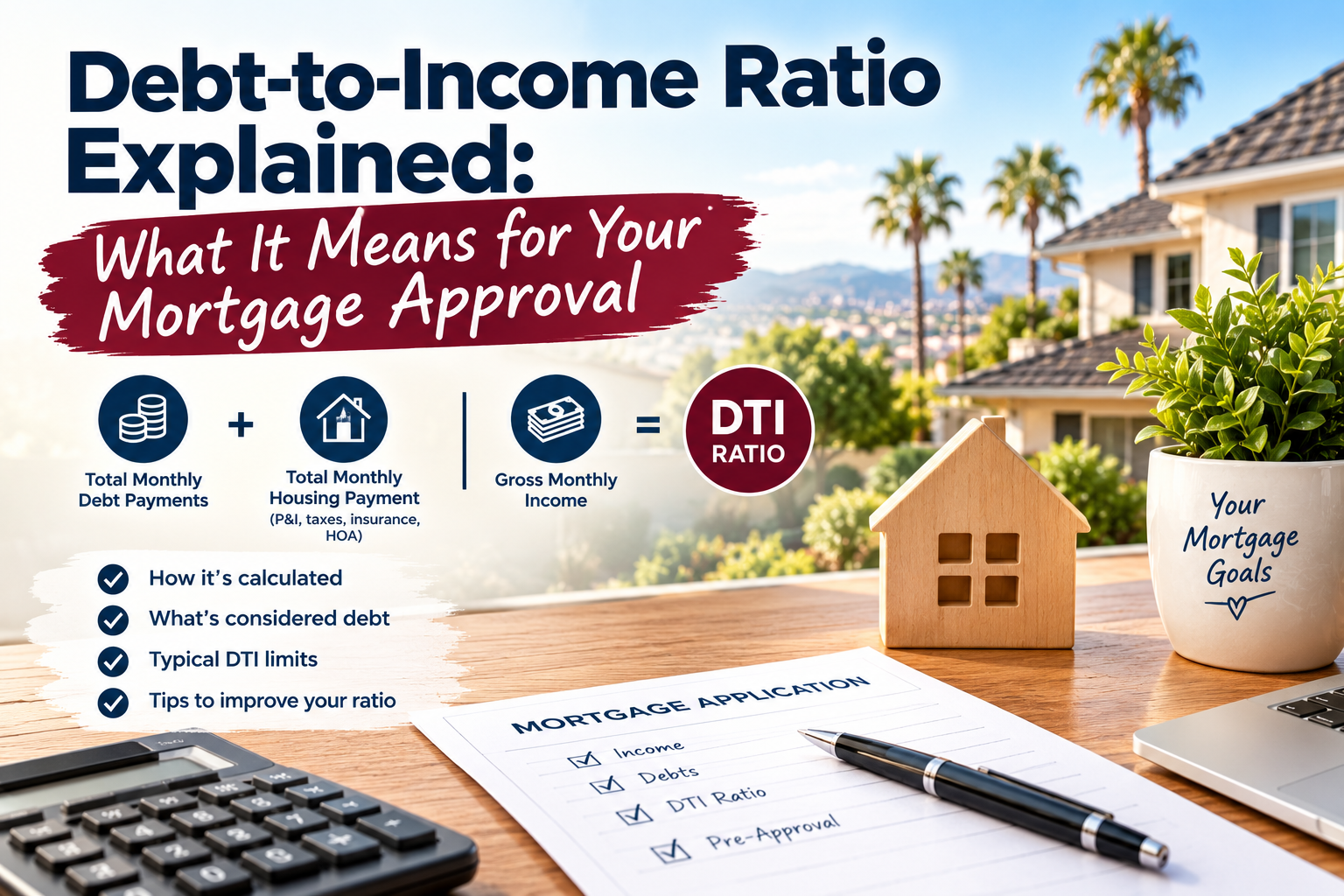

Debt-to-Income Ratio Explained: What It Means for Your Mortgage Approval
Ask most first-time buyers what lenders look at, and they’ll say credit score. That’s part of it. But the number that most often decides how much you can borrow is your debt-to-income ratio, or DTI. It’s the number I run first on almost every file, and it’s the one buyers know the least about.
The short answer: for most loans, aiming for a DTI of 43% or lower puts you in a comfortable spot. Many approvals go higher, up to the mid-40s on conventional loans and into the 50s on some FHA and Non-QM files, and VA loans work a little differently. Here’s how it’s calculated, what each loan type allows, and how to improve yours before you apply.
What DTI Is and How It’s Calculated
Your DTI compares your monthly debt payments to your gross monthly income, which is your income before taxes. It tells a lender how much of your income is already spoken for.
DTI = Total monthly debt payments ÷ Gross monthly income
What counts as debt:
- Your proposed new housing payment (principal, interest, taxes, insurance, and HOA dues if applicable)
- Minimum credit card payments
- Auto loans
- Student loans
- Personal loans
- Child support or alimony
- Payments on any other mortgages you own
What doesn’t count: Everyday living costs like groceries, utilities, phone bills, gas, and insurance premiums aren’t part of the calculation, even though they feel like debts.
Front-End vs. Back-End DTI
Lenders actually look at two ratios.
Front-end DTI (also called the housing ratio) only includes your new housing payment. It answers: how much of your income goes to the home itself?
Back-end DTI (also called the total ratio) includes your housing payment plus all your other monthly debts. This is the number most loan programs focus on.
A Quick Example
Say you earn $9,000 per month before taxes, and you’re looking at a home with a total monthly housing payment of $3,000. You also have a $450 car payment, a $300 student loan payment, and $150 in minimum credit card payments, which totals $900 in other debts.
- Front-end DTI: $3,000 ÷ $9,000 = 33.3%
- Back-end DTI: ($3,000 + $900) ÷ $9,000 = 43.3%
In Southern California, housing payments are large, so your back-end ratio can climb quickly. HOA dues and special assessments, like Mello-Roos taxes in many newer communities, add to the housing payment and push both ratios up, so we include them early.
Maximum DTI by Loan Type
There’s no single pass-or-fail number. Each program has a standard guideline and a higher ceiling for stronger files.
| Loan Type | Standard Guideline | What Approval Can Reach With a Strong File |
|---|---|---|
| Conventional | About 36% to 45% | Up to about 50% through automated underwriting |
| FHA | 31% front-end / 43% back-end | Automated approvals can go up to about 56.9% back-end (many lenders cap lower) |
| VA | 41% back-end guideline | No hard cap; residual income is the key factor |
| Non-QM | Varies by program | Often around 50%, and some programs go higher |
Conventional loans are the most restrictive. A DTI above 45% generally needs strong credit (often 700 or higher), solid reserves, and a lower loan-to-value to get an automated approval.
FHA loans are the most forgiving among the standard programs. The published guideline is 31% and 43%, but automated underwriting regularly approves higher ratios when the file has compensating factors like cash reserves or strong credit. The catch is that many lenders add their own limits below what FHA allows, which is one reason it’s worth working with a lender who knows where the flexibility actually is.
VA loans treat DTI as a guideline, not a hard cap. A 41% back-end ratio is the benchmark, but VA also looks at residual income, meaning what’s left over each month after your major expenses and debts, based on your family size and region. A veteran with a DTI above 41% and strong residual income can still be approved.
Non-QM loans can accommodate higher ratios, with many bank statement programs allowing around 50% and some going higher. DSCR loans for investment properties don’t use DTI at all, since they qualify the property’s rent instead of your personal income.
How to Lower Your DTI Before You Apply
If your ratio is higher than you’d like, you have two levers: reduce your monthly debts, or increase your documented income.
Pay down or pay off debts with high payments relative to their balance. Car loans and personal loans often have large monthly payments for their balance, so paying one off can drop your DTI quickly. Credit cards work differently: lenders count the minimum payment, so paying a card down to zero removes its payment from the calculation entirely.
Look at loans that are almost paid off. In many cases, an installment loan with only a few months left can be excluded from your DTI. Ask me before you make extra payments, since the rules depend on the loan type and how close it is to being paid off.
Don’t take on new debt. A new car loan or new credit card right before applying can undo months of progress. Wait until after closing.
Add a co-borrower, if it makes sense. A spouse or family member with documented income can lower the combined ratio, though their debts and credit come into the file too.
Pay attention to student loans. Lenders have specific rules for how they calculate a student loan payment, especially if you’re on an income-driven plan with a low or $0 payment. It can change your number, so tell me what you have.
Avoid draining the money you need for closing. Paying off debt helps your DTI, but not at the expense of your down payment, closing costs, or required reserves.
Debt Payoff vs. Income Increase: Which Moves the Needle Faster?
Using the example above, with a 43.3% back-end ratio:
Option A: Pay off the $450 car payment. That one change reduces your debts by $450 per month. Your back-end ratio drops from 43.3% to 38.3%, a full five percentage points. This is a one-time action, and it can happen in weeks, provided you have the cash to do it.
Option B: Increase your income. To get the same drop to 38.3% with your debts staying at $3,900, your gross income would need to rise from $9,000 to roughly $10,170 per month. That’s about a 13% raise. A raise is great, but you can’t speed it up, and lenders need to verify it.
In most cases, paying off a high-payment installment debt moves the needle faster. It’s under your control and works immediately. Income increases are powerful, but they take longer, and income from a new job, a second job, or self-employment usually needs a documented history before a lender counts it. A raise from your current employer, on the other hand, can usually be counted once it’s verified.
The best approach is often both: pay off the debts that make the biggest difference, and make sure every dollar of your real income is documented and counted.
Don’t Guess. Check Your Number.
Your DTI isn’t fixed, and a few smart moves before you apply can change what you qualify for. The earlier we look at it, the more options you have.
Let’s Run Your DTI
Send me your monthly income, your monthly debt payments, and the price range you’re considering. I’ll calculate your front-end and back-end ratios, show you what each loan type would allow, and tell you which debts are worth paying down first.
Adam Tice Senior Loan Officer, Mark 1 Mortgage — Team Tice NMLS #289398 📞 626-825-2326 ✉️ adam@adamtice.com 🌐 adamtice.com

No responses yet