
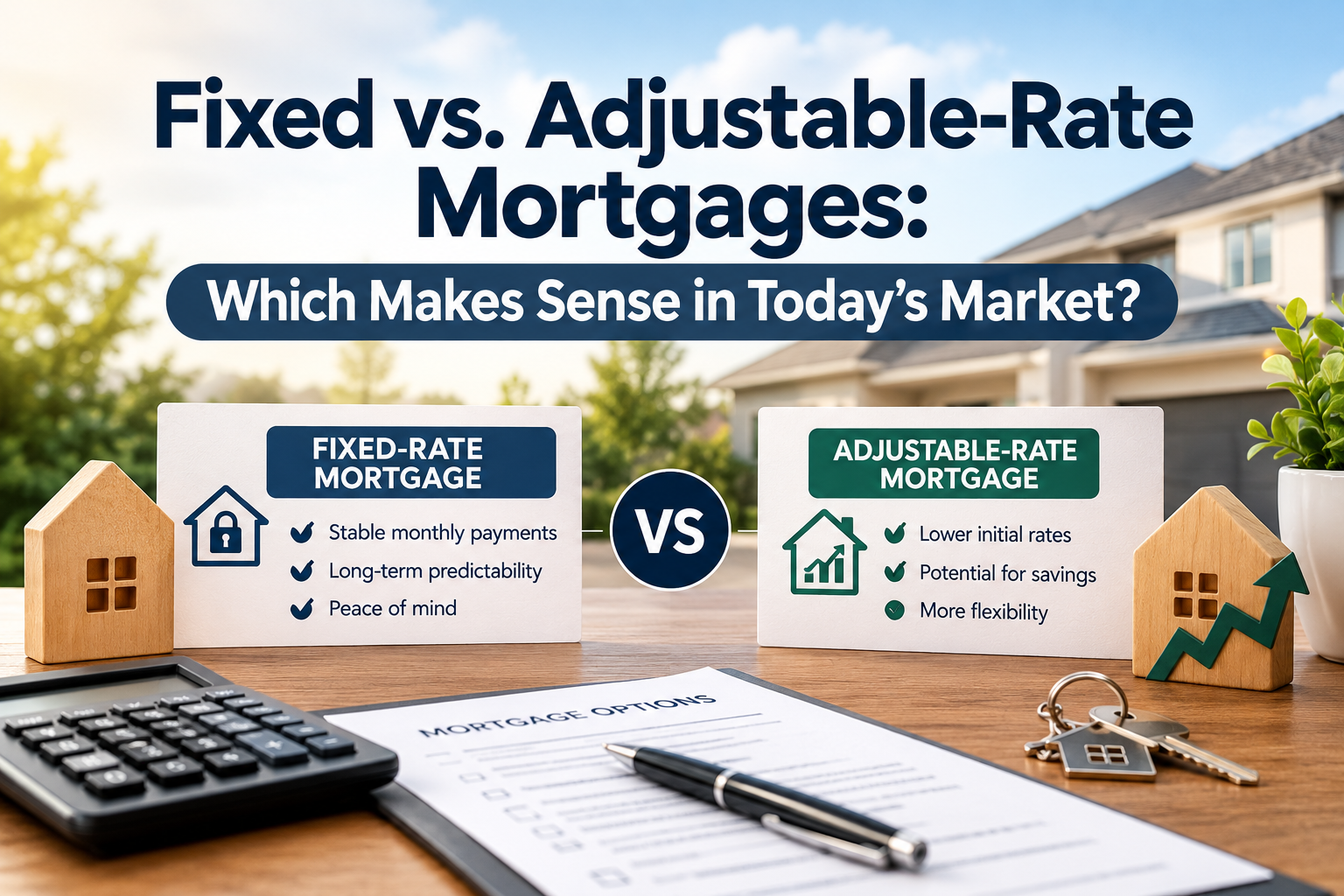

Fixed vs. Adjustable-Rate Mortgages: Which Makes Sense in Today’s Market?
“Should I get a fixed or adjustable rate?” is one of those questions that sounds simple but actually depends entirely on one thing most buyers haven’t thought through yet: how long you actually plan to keep this loan. Here’s how ARMs really work, when they save real money, and the math that should drive your decision instead of a gut feeling about rates.
How ARMs Actually Work
An adjustable-rate mortgage isn’t adjustable from day one — it starts with a fixed period, then adjusts periodically after that. The naming convention tells you exactly how this works:
5/1 ARM: Fixed for the first 5 years, then adjusts once per year after that. 7/1 ARM: Fixed for the first 7 years, then adjusts once per year after that. 10/1 ARM: Fixed for the first 10 years, then adjusts once per year after that.
During the initial fixed period, your rate and payment behave exactly like a fixed-rate loan — completely stable, no surprises. The difference only shows up after that period ends.
Adjustment caps protect you from unlimited increases. ARMs come with structured caps, typically expressed as three numbers (for example, 2/2/5): the maximum the rate can increase at the first adjustment, the maximum it can increase at each subsequent adjustment, and the maximum it can increase over the life of the loan. These caps mean an ARM can’t spiral upward without limit — there’s a real ceiling built into the loan terms, even in a rising rate environment.
Your new rate after adjustment is based on an index plus a margin. The index reflects current market rates (common benchmarks include SOFR or similar), and the margin is a fixed amount set at origination that doesn’t change. Your post-adjustment rate moves with the broader rate environment, within your capped limits.
When an ARM Actually Saves Real Money
ARMs typically offer a lower initial rate than a comparable fixed-rate loan — this is the core trade-off: a discount during the fixed period in exchange for rate uncertainty afterward. Whether that discount is worth it comes down to two things:
How large is the rate discount right now? The spread between fixed and ARM rates isn’t constant — it widens and narrows depending on market conditions. Sometimes the discount is substantial enough to make an ARM compelling even for buyers who might stay long-term. Other times, the spread is narrow enough that the extra risk isn’t worth a marginal savings. I’ll always show you the actual current spread between fixed and ARM pricing before you decide, since it genuinely changes how this math works.
How long will you actually hold this loan? This is the single biggest factor, and it’s worth being honest with yourself about. If you sell or refinance before the fixed period ends, you captured the ARM’s lower rate for your entire time in the loan and never faced an adjustment at all — meaning you saved money the whole time you held it, with zero downside realized.
The “I’m Only Staying 5 Years” Scenario
This is the classic case where an ARM genuinely makes sense, and it comes up constantly with SoCal buyers — a growing family expecting to move up in a few years, a job that may relocate you, or simply a starter home you already know isn’t your forever home.
If you’re confident you’ll sell or refinance within the fixed period, a 5/1 ARM lets you capture a lower rate for the entire time you actually hold the loan, with no exposure to the adjustment phase at all — because you’ll be out of the loan before it ever adjusts. In this scenario, the “risk” of an ARM is largely theoretical, since you never reach the point where it matters.
The honest caveat: life plans change. If your 5-year plan becomes a 9-year reality because you didn’t sell when you expected to, you’ll face an adjustment — which, thanks to the caps, won’t be unlimited, but could mean a real payment increase if rates have risen by that point.
Break-Even Math: How to Actually Decide
Rather than guessing, here’s the framework I walk buyers through:
Step 1: Calculate your monthly savings with the ARM. Compare the ARM’s initial payment against a comparable fixed-rate loan’s payment at current pricing.
Step 2: Multiply that monthly savings by the number of months you plan to hold the loan. This gives you your total expected savings during the fixed period.
Step 3: Weigh that savings against the risk. Ask yourself honestly: if your plans changed and you held this loan past the fixed period, what’s the realistic worst-case payment increase under the ARM’s caps, and could you comfortably absorb that if it happened?
If the total expected savings are substantial and your timeline is reasonably confident, an ARM often makes real financial sense. If the spread between fixed and ARM rates is currently narrow, or your timeline is genuinely uncertain, the stability of a fixed rate is often worth more than the marginal savings — not because ARMs are risky in some abstract sense, but because the math simply doesn’t favor them as strongly in that specific scenario.
There’s No Universal Right Answer
Fixed-rate loans aren’t automatically the “safe” choice and ARMs aren’t automatically the “risky” one — both are tools that fit different situations well. A buyer planning to stay in a home for 20+ years is usually better served by the certainty of a fixed rate. A buyer with a realistic, well-founded 5-to-7-year timeline may come out ahead with an ARM’s lower initial rate, assuming the current spread makes it worthwhile.
The decision should be driven by your actual plans and the real numbers available right now — not a general feeling about which type of loan sounds safer.
Let’s Run Your Actual Numbers
Send me your timeline and I’ll show you the current fixed and ARM rates side by side, your real monthly savings under each scenario, and the break-even math specific to your situation — so you can decide with real numbers, not a guess.
Adam Tice Senior Loan Officer, Mark 1 Mortgage — Team Tice NMLS #289398 📞 626-825-2326 ✉️ adam@adamtice.com 🌐 adamtice.com

Comments are closed