
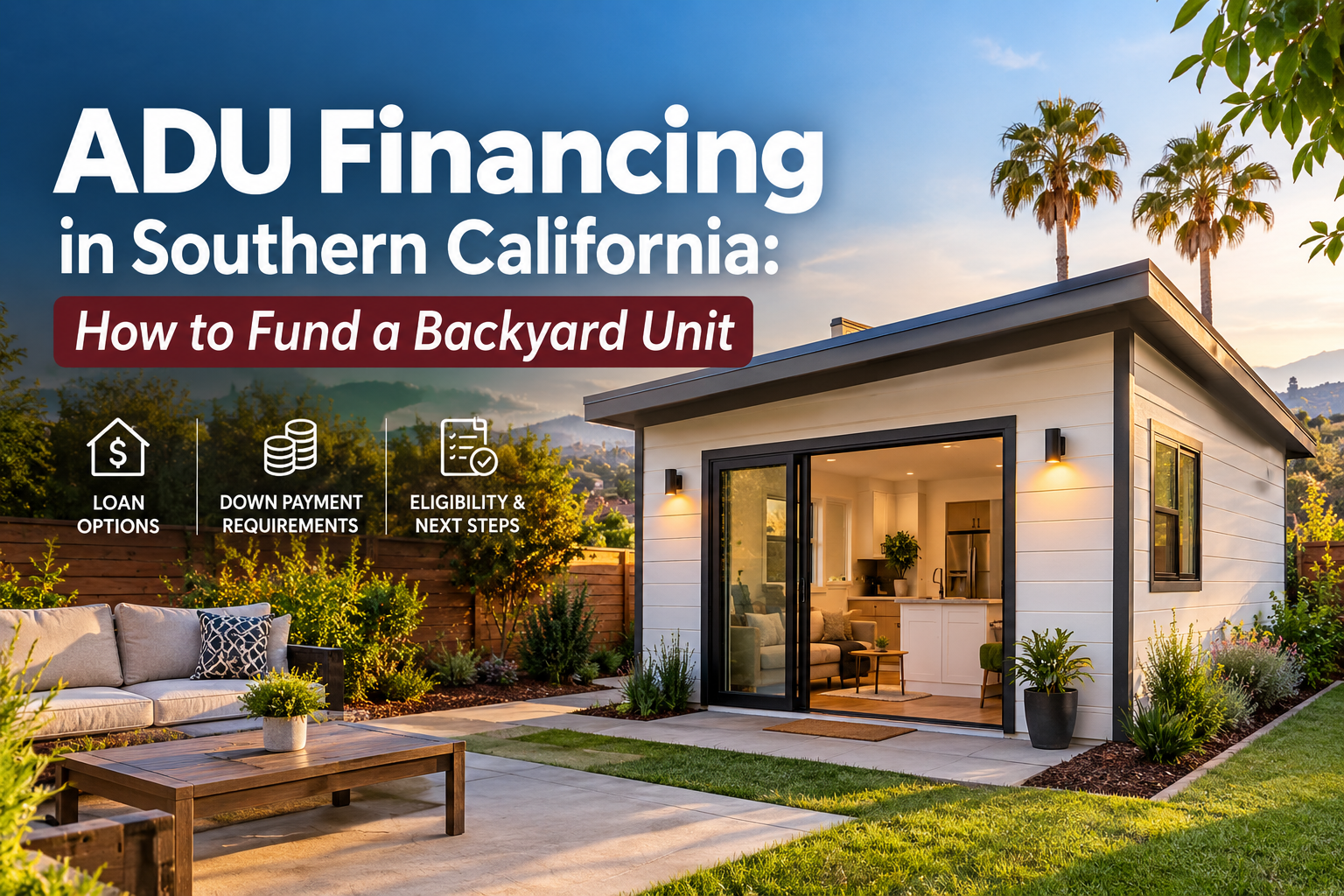

ADU Financing in Southern California: How to Fund a Backyard Unit
Accessory dwelling units — ADUs, or what most people just call backyard units, granny flats, or in-law suites — have gone from a niche option to one of the most common home improvement projects across LA County, the San Gabriel Valley, and the Inland Empire. If you’re a homeowner considering one, financing is usually the first real question, and there’s more than one path to getting it done.
Here’s why ADUs have taken off in Southern California, how the financing options actually compare, and what the permitting timeline realistically looks like before you commit.
Why ADUs Are Booming in Southern California
A few forces have converged to make ADUs one of the most practical projects a SoCal homeowner can take on right now:
Rental income potential is real and significant. In a region where rents remain high across LA County, the SGV, and the IE, a well-built ADU can generate meaningful monthly rental income — often enough to substantially offset or even fully cover the cost of financing the project itself.
Multi-generational living has become far more common. Rising home prices have made it increasingly practical for adult children, aging parents, or extended family to live on the same property in a separate, private unit rather than buying or renting a second home entirely.
State law has made this dramatically easier than it used to be. California has passed a series of laws over recent years specifically to streamline ADU approval, reduce local government obstacles, and in many cases eliminate parking requirements and other barriers that used to make ADUs difficult or impossible to build in many single-family zones.
Property value increases can be substantial. Beyond rental income, a permitted, well-built ADU adds real resale value — appraisers increasingly recognize ADUs as meaningful square footage and income-generating potential, not just an accessory afterthought.
Financing Options Compared
HELOC (Home Equity Line of Credit)
A HELOC lets you draw against your home’s existing equity as needed, functioning similarly to a credit card secured by your property. This is a popular choice for ADU projects because you only draw and pay interest on what you actually use, which fits well with a phased construction draw schedule.
Best for: Homeowners with substantial existing equity who want flexible, as-needed access to funds without refinancing their entire first mortgage.
Cash-Out Refinance
This replaces your current mortgage with a new, larger one, and you receive the difference in cash to fund the ADU build. Unlike a HELOC, this changes your primary mortgage entirely, including potentially your rate.
Best for: Homeowners who want to roll the ADU cost into a single new fixed-rate loan, particularly if current rates are favorable compared to their existing mortgage, or if they’d rather have one predictable payment than a separate line of credit.
Renovation/Construction Loans
These are loans specifically structured for construction projects, disbursing funds in stages (draws) as work is completed, often converting into permanent financing once the ADU is finished. Some programs are specifically designed for ADU construction and can factor projected rental income into qualification even before the unit is built.
Best for: Homeowners without significant existing equity to draw against, or those who want a loan structure specifically built around a construction timeline with staged inspections and draws.
How Projected Rental Income Can Help You Qualify
This is one of the most useful, and least understood, aspects of ADU financing. Certain loan programs — particularly renovation and construction loans designed specifically for ADUs — allow a lender to count a portion of the ADU’s projected future rental income toward your qualifying income for the loan, even before the unit is built or rented.
This typically works through an appraiser’s rent schedule, similar to how rental income is evaluated for other investment financing, estimating fair market rent for the completed unit based on comparable local rentals. A percentage of that projected rent (commonly 75%) can then be added to your qualifying income, which can make a meaningful difference in whether you qualify for the full loan amount needed to complete the project.
Not every loan program allows this, and the exact treatment varies by lender and loan type — this is exactly the kind of detail worth confirming upfront, since it can significantly change what you’re able to borrow.
Permitting Timeline: A Reality Check
Financing is only half the equation — the permitting and construction timeline deserves honest expectations before you commit to a project or a loan structure:
Plan review and permitting typically takes anywhere from a few weeks to a few months, varying significantly by city. Some LA County and SGV cities have streamlined ADU-specific review processes given state mandates; others still move more slowly in practice despite those same state requirements.
Construction itself commonly runs 4 to 8 months for a typical detached ADU, depending on size, whether it’s a new structure or a conversion (like a garage conversion), and how busy local contractors are at the time.
Inspections and final sign-off add additional time on the back end, and delays here are common — scheduling inspector availability and passing all required inspections rarely happens on the first attempt.
All told, most homeowners should realistically plan for 8 to 14 months from the decision to build to a fully permitted, move-in-ready or rent-ready ADU. This matters directly for financing choice — a construction loan’s draw schedule and timeline assumptions should be built around a realistic project length, not an optimistic best-case scenario, to avoid running into cash flow gaps mid-project.
Which Financing Option Actually Fits Your Project?
The right choice usually comes down to three factors: how much existing equity you have, whether you want flexible draw-as-needed access or a single lump-sum loan, and whether you need projected rental income counted toward qualification to make the numbers work at all.
A homeowner with substantial equity and no need for rental income to qualify often does well with a straightforward HELOC. A homeowner who wants to lock in a single new rate and doesn’t mind refinancing their whole mortgage may prefer a cash-out refinance. A homeowner who needs the projected rental income counted to qualify for the full construction amount typically needs a renovation or construction loan program built specifically for that purpose.
Let’s Find the Right Financing for Your ADU
If you’re considering an ADU anywhere in LA County, the San Gabriel Valley, or the Inland Empire, send me your equity position and project scope and I’ll walk you through which financing option — HELOC, cash-out refinance, or a construction loan using projected rental income — actually fits your numbers.
Adam Tice Senior Loan Officer, Mark 1 Mortgage — Team Tice NMLS #289398 📞 626-825-2326 ✉️ adam@adamtice.com 🌐 adamtice.com

Comments are closed