
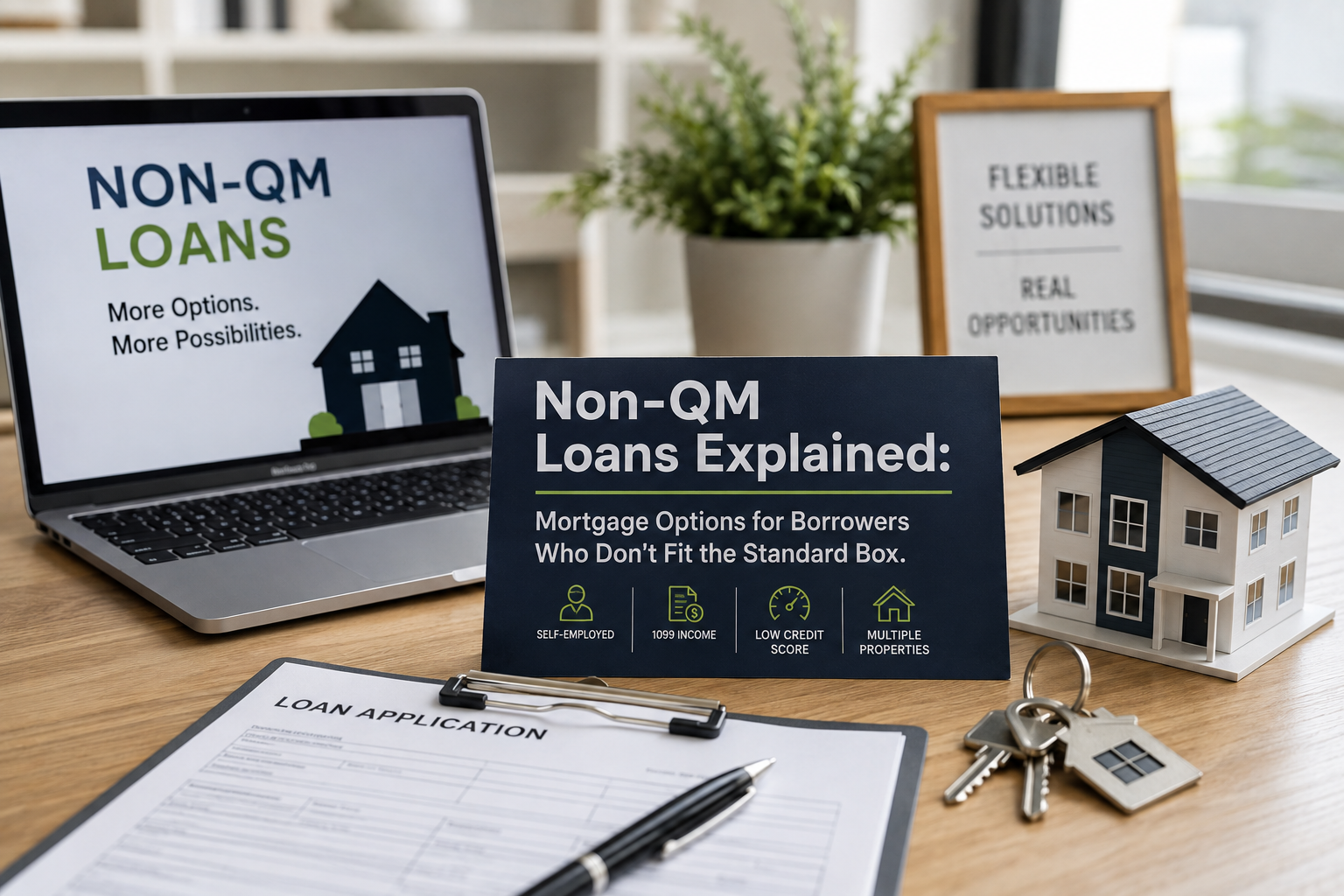

Non-QM Loans Explained: Mortgage Options for Borrowers Who Don’t Fit the Standard Box
“Non-QM” sounds like a warning label — like something’s wrong with the loan, or with you as a borrower. It’s not. Non-QM simply means a loan that doesn’t follow the standard guidelines set by Fannie Mae, Freddie Mac, FHA, or VA. It exists because a huge number of financially strong borrowers in LA and Orange County simply don’t fit into those standardized boxes, through no fault of their own.
Here’s what Non-QM actually means, who it’s built for, and when it’s genuinely worth the higher rate.
What “Non-QM” Actually Means
QM stands for “Qualified Mortgage” — a category defined by federal regulation that follows specific, standardized underwriting rules, largely built around traditional W-2 income documentation. Non-QM simply means a loan that falls outside those specific rules.
Non-QM does not mean non-qualifying, subprime, or risky by definition — that reputation is left over from a different era of lending before current Non-QM standards existed. Today’s Non-QM loans still require full underwriting, real documentation (just different documentation than a standard file), and genuine ability-to-repay verification. They just don’t force every borrower into the same standardized income-documentation model that works well for a salaried employee but poorly for a lot of other financially strong people.
The Four Main Non-QM Borrower Types
1. Self-Employed Borrowers (Bank Statement Loans) Traditional underwriting relies on tax returns — which, for many self-employed borrowers, show a much lower income than they actually earn, thanks to legitimate business write-offs and deductions. Bank statement loans qualify you based on 12-24 months of actual bank deposits instead, reflecting your real cash flow rather than your taxable income.
2. Real Estate Investors (DSCR Loans) DSCR loans qualify based on a rental property’s own income rather than your personal income at all — useful for investors who own multiple properties, have complex personal tax situations, or simply don’t want their investment financing tied to personal income documentation.
3. Credit-Event Borrowers Some Non-QM programs allow financing shortly after a foreclosure, short sale, or bankruptcy — well before standard FHA or conventional waiting periods have elapsed — for borrowers who are financially recovered but haven’t hit the required seasoning timeline yet.
4. Foreign National Borrowers Buyers without U.S. credit history or U.S.-based income — common among LA and Orange County buyers purchasing investment or second homes from abroad — generally can’t qualify for standard financing at all, since conventional and FHA underwriting requires U.S. credit and income documentation. Non-QM foreign national programs are often the only realistic financing path for this group.
Asset Depletion Loans: For High-Net-Worth Borrowers With Low Income on Paper
This is a Non-QM category worth calling out specifically, because it solves a very particular and surprisingly common problem: a borrower with substantial assets — investments, retirement accounts, savings — but relatively low documented monthly income, often because they’re retired, between active income sources, or simply keep most of their wealth in assets rather than salary.
Asset depletion loans qualify you by converting your liquid assets into a hypothetical monthly income figure, typically by dividing your qualifying asset total by a set number of months (commonly 240 or 360). A borrower sitting on several million dollars in investment accounts but showing modest monthly income on paper can qualify for a substantial loan amount this way — something that would be difficult or impossible under standard income-based underwriting, even though the borrower is clearly financially strong.
This shows up often in LA and Orange County among retirees, recently sold-business owners, and high-net-worth individuals whose wealth doesn’t translate cleanly into a conventional pay stub.
Foreign National Programs: Relevant for LA and OC Buyer Profiles
Los Angeles and Orange County both see consistent international buyer activity — investment purchases, second homes, and buyers relocating to the U.S. without an established domestic financial history. Foreign national Non-QM programs are built specifically for this profile:
- No U.S. credit score required in most cases
- Income documentation typically comes from foreign income sources, foreign bank statements, or asset-based qualification
- Larger down payments are standard, often in the 25%–40% range depending on the specific program and property type
- Some programs require a U.S. bank account be established for the transaction, even if ongoing income stays overseas
For international buyers specifically targeting LA or OC real estate, this is very often the only viable financing path, since standard U.S. mortgage products simply aren’t built to evaluate a foreign income and credit profile.
The Non-QM Rate Premium: What It Costs and When It’s Worth It
Non-QM loans carry higher rates than conventional or FHA financing — this is the honest tradeoff for the flexibility. Depending on the specific program, borrower profile, and down payment, Non-QM rates commonly run somewhere in the range of 1%–3% above comparable conventional pricing, though the exact premium varies significantly by program type and individual file strength.
When it’s worth it:
- You genuinely can’t qualify any other way — self-employed income that doesn’t show enough on tax returns, a recent credit event, or foreign national status with no path to conventional financing
- The alternative is renting or missing a specific purchase opportunity while you wait years to qualify conventionally
- You plan to refinance into conventional financing once your situation changes — for example, once you’re further past a credit event’s waiting period, or once you’ve filed enough tax returns showing stronger income under a new business structure
When it’s not worth it:
- You could qualify conventionally with a bit more preparation — sometimes restructuring how income is documented, or simply waiting a short additional period, saves substantially more than the rate premium costs
- The rate difference isn’t justified by your specific timeline or urgency
This is exactly the kind of decision worth running real numbers on rather than assuming — sometimes Non-QM is clearly the right call, and sometimes a few months of preparation gets you into a meaningfully better conventional rate instead.
Let’s Find the Right Fit for Your Situation
If your income, credit history, or residency status doesn’t fit neatly into a standard mortgage box, send me your situation and I’ll walk you through which Non-QM program fits — bank statement, DSCR, asset depletion, or foreign national — and what it would actually cost compared to your alternatives.
Adam Tice Senior Loan Officer, Mark 1 Mortgage — Team Tice NMLS #289398 📞 626-825-2326 ✉️ adam@adamtice.com 🌐 adamtice.com

Comments are closed