
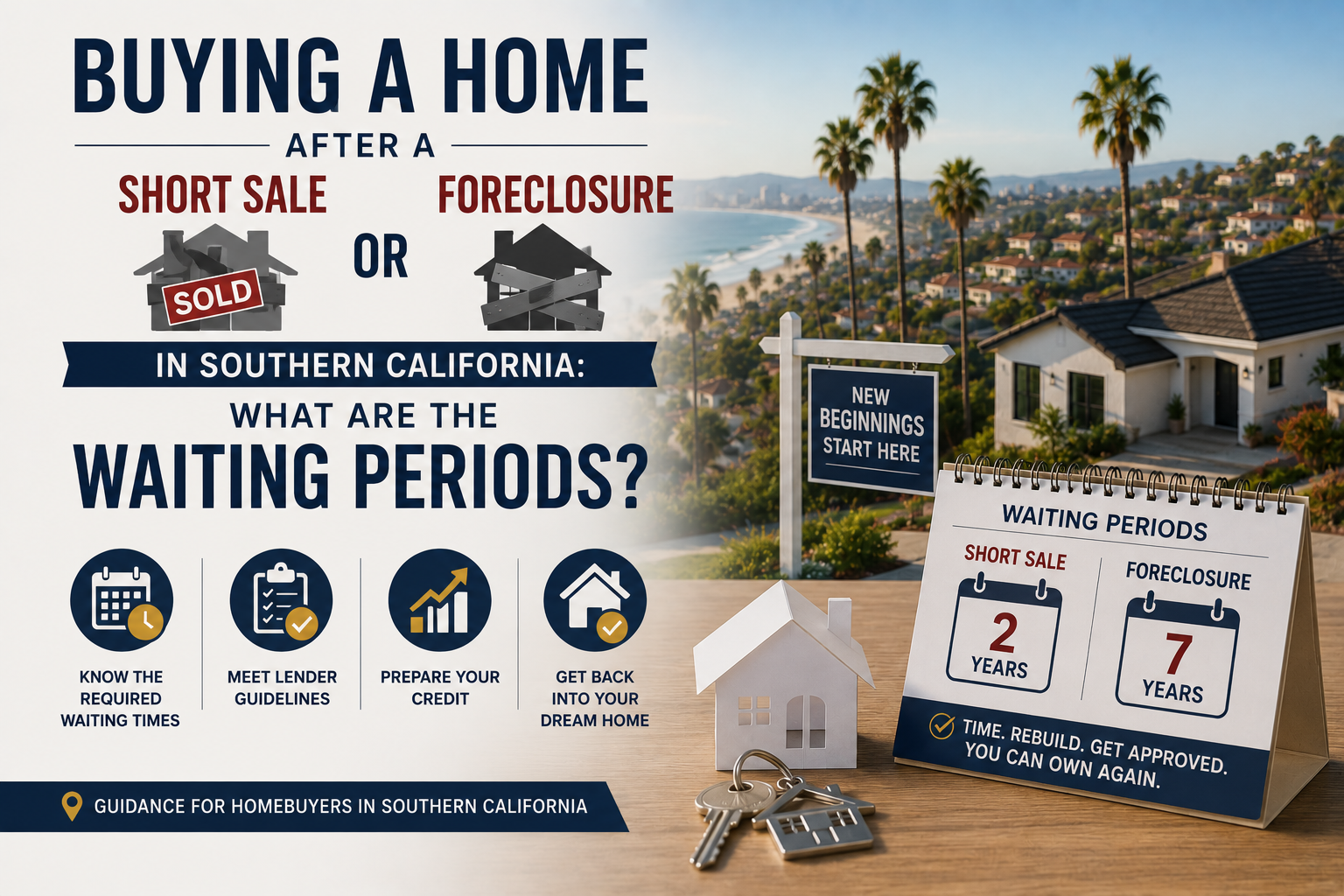

Buying a Home After a Short Sale or Foreclosure in Southern California: What Are the Waiting Periods?
How long after foreclosure can I buy a house in California?
If you went through a foreclosure or short sale years ago, you may assume that buying another home is still out of reach. That may not be the case.
Many Southern California homeowners experienced financial hardship during the housing crisis and subsequent economic downturns. In areas throughout the Inland Empire (IE), San Gabriel Valley (SGV), and greater Southern California, some borrowers who experienced a foreclosure or short sale between 2009 and 2013 may now be well beyond the applicable waiting period.
The important question is not simply whether you had a foreclosure or short sale.
It is when the event occurred, what caused it, what your credit looks like today, and which loan program you qualify for.
Depending on your circumstances, you may be able to qualify for an FHA, Conventional, VA, or Non-QM mortgage after a credit event.
How Long After Foreclosure Can I Buy a House in California?
The waiting period depends heavily on the mortgage program you are using.
As a general guideline, borrowers may encounter the following timelines:
| Loan Type | Foreclosure | Short Sale |
|---|---|---|
| FHA | Generally 3 years | Generally 3 years |
| Conventional | Generally 7 years | Generally 4 years |
| VA | Often around 2 years | Potentially shorter depending on circumstances |
| Non-QM | May allow financing much sooner | May allow financing much sooner |
These are general guidelines, not automatic approval rules. Your actual eligibility can depend on the specific circumstances surrounding the credit event, your current credit profile, income, assets, debt-to-income ratio, down payment, and the lender’s underwriting requirements.
That is why borrowers who were told they have to “wait seven years” should not necessarily assume that applies to every loan option.
FHA Loans After a Foreclosure or Short Sale
FHA financing can be an attractive option for borrowers rebuilding after a major credit event.
Foreclosure
Under standard FHA guidelines, a borrower generally faces a three-year waiting period after foreclosure before becoming eligible for FHA financing.
However, there can be exceptions when the foreclosure resulted from documented extenuating circumstances.
Examples may include serious financial hardship outside the borrower’s control, depending on the circumstances and documentation.
The key is that an exception is not automatic.
A lender may need documentation showing what happened, why the event occurred, and why the borrower is now financially stable.
Short Sale
A short sale may also have a waiting period under FHA guidelines, although the circumstances surrounding the transaction can affect eligibility.
If the short sale occurred several years ago, the most important step may simply be determining whether the applicable waiting period has already expired.
For someone who completed a short sale in 2011 or 2012, for example, the event may be far enough in the past that it is no longer the primary obstacle to obtaining a mortgage.
Conventional Loans After a Foreclosure
Conventional financing can have a longer standard waiting period following foreclosure.
A commonly cited guideline is approximately seven years after foreclosure, although certain documented extenuating circumstances may reduce the waiting period.
This is one reason borrowers sometimes believe they cannot qualify for a conventional mortgage even though other loan programs may be available.
The important distinction is between:
“I cannot qualify for a conventional loan right now.”
and
“I cannot buy a home at all.”
Those are two very different statements.
If conventional financing is not currently available, an FHA, VA, or Non-QM option may potentially provide another path depending on your circumstances.
Conventional Loans After a Short Sale
The waiting period following a short sale can be shorter than the standard foreclosure waiting period.
A commonly referenced conventional guideline is approximately four years, although circumstances and lender requirements can affect eligibility.
For example, a borrower who completed a short sale several years ago may have already satisfied the applicable waiting period.
At that point, the focus shifts toward the rest of the mortgage application:
- Current credit score
- Payment history
- Income stability
- Debt-to-income ratio
- Employment history
- Available assets
- Down payment
- Property type
- Overall credit profile
The short sale itself may no longer be the biggest issue.
VA Loans After Foreclosure or Short Sale
Eligible veterans and service members may have another potential path through VA financing.
VA guidelines can be more flexible than conventional financing following certain credit events.
A foreclosure does not necessarily mean a veteran is permanently unable to use their VA home loan benefit.
A commonly referenced guideline is approximately two years after foreclosure, although eligibility can depend on the circumstances and the lender’s underwriting requirements.
Short sales can also be evaluated differently from foreclosures.
If you are a veteran who experienced a foreclosure or short sale years ago, it is worth having your situation reviewed rather than assuming you are automatically disqualified from using your VA benefit.
What About Non-QM Loans After a Foreclosure?
This is where things can become particularly interesting for borrowers with recent credit events.
Non-QM (Non-Qualified Mortgage) loans can provide alternative financing options for borrowers who don’t fit traditional agency guidelines.
Depending on the lender and loan program, some Non-QM programs may allow financing very shortly after a foreclosure, short sale, bankruptcy, or other major credit event.
Some programs are marketed with extremely short waiting periods, including “one day out” scenarios.
However, that does not mean everyone can buy a house the day after a foreclosure.
Non-QM lenders may compensate for increased credit risk through requirements such as:
- Larger down payments
- Higher interest rates
- Higher reserve requirements
- Different debt-to-income requirements
- Alternative income documentation
- Stronger overall financial profiles
Think of Non-QM financing as an alternative financing strategy, rather than a guaranteed shortcut.
For some borrowers, it can serve as a bridge until they qualify for a more traditional mortgage.
What Are Extenuating Circumstances?
One of the most important concepts for borrowers with a past foreclosure is extenuating circumstances.
An extenuating circumstance is generally a serious event outside the borrower’s control that contributed to the financial hardship.
Depending on the mortgage program, examples may include circumstances such as:
- Serious illness
- Death of a primary wage earner
- Significant documented loss of income
- Major natural disaster
- Other qualifying events outside the borrower’s control
The exact definition and documentation requirements depend on the loan program.
Simply saying that the foreclosure was caused by financial hardship may not be enough.
A lender may need supporting documentation showing what happened and how the event affected your ability to make your mortgage payments.
How to Rebuild Your Credit While Waiting
If you are still within a mortgage waiting period, that does not mean you should simply sit and wait.
The years leading up to your next mortgage application can be used strategically.
1. Make Every Payment on Time
Payment history is one of the most important parts of your credit profile.
After a major credit event, establishing a consistent history of on-time payments can demonstrate that your financial situation has stabilized.
2. Keep Credit Card Balances Under Control
High credit utilization can negatively affect your credit profile.
If possible, avoid carrying large revolving balances relative to your available credit.
3. Avoid Unnecessary New Debt
Buying a new vehicle or opening multiple credit accounts shortly before applying for a mortgage can complicate your financial profile.
Before taking on significant new debt, consider how it could affect your future mortgage qualification.
4. Save for Your Down Payment
A larger down payment can potentially improve your financing options.
It can also help offset some of the challenges associated with alternative financing programs.
5. Build Cash Reserves
Don’t focus exclusively on the down payment.
Mortgage lenders may also evaluate your available reserves, and having additional funds after closing can strengthen your overall financial position.
6. Monitor Your Credit Reports
Check your credit reports periodically for inaccurate information.
If an old account is being reported incorrectly, resolving the issue before applying for a mortgage can prevent unnecessary complications.
Southern California Borrowers May Have More Options Than They Think
The Inland Empire and San Gabriel Valley experienced significant housing-market volatility during the financial crisis.
Many homeowners faced foreclosure, short sales, job losses, declining property values, and other financial challenges during that period.
But a borrower who experienced a foreclosure in 2010 is in a very different position today than someone who experienced one last year.
For borrowers whose credit events occurred more than a decade ago, the original event may no longer be the biggest issue.
Instead, lenders may be more concerned with your current financial picture.
That means it can be worthwhile to review your situation even if you believe your past foreclosure or short sale automatically disqualifies you.
Can I Buy a House If My Foreclosure Was Only a Few Years Ago?
Possibly.
The answer depends on the loan program and your individual circumstances.
For example, a borrower may not currently meet the standard requirements for conventional financing but could potentially qualify through another mortgage program.
A borrower with a recent credit event might also explore a Non-QM loan and later refinance into a conventional or government-backed mortgage once they become eligible.
This strategy can sometimes be thought of as a bridge-to-traditional-financing approach.
However, borrowers should carefully compare the costs, interest rate, fees, and long-term implications before choosing an alternative loan.
What If My Foreclosure Was More Than 7 Years Ago?
If your foreclosure occurred more than seven years ago, the standard conventional waiting period may no longer be the primary issue.
At that point, your lender will generally focus much more heavily on your current financial profile.
You may want to have your:
- Credit reports
- Credit scores
- Income
- Employment history
- Debts
- Assets
- Down payment
- Mortgage payment history
reviewed before assuming you cannot qualify.
A credit event from more than a decade ago does not necessarily tell a lender what your financial situation looks like today.
Short Sale vs. Foreclosure: What’s the Difference?
A short sale occurs when a property is sold for less than the amount owed on the mortgage and the lender agrees to accept the proceeds under the terms of the transaction.
A foreclosure occurs when the lender takes legal action to recover the property after the borrower defaults on the mortgage.
Both can have a significant impact on credit.
However, mortgage underwriting rules can treat the two events differently.
That’s why someone who completed a short sale may have a different path to homeownership than someone who went through foreclosure at roughly the same time.
Frequently Asked Questions
How long after foreclosure can I buy a house in California?
There is no single waiting period that applies to every borrower.
For many borrowers, the standard FHA waiting period is around three years, conventional financing may require around seven years, and VA financing may have a shorter waiting period. Certain circumstances and loan programs may provide exceptions or alternative options.
Can I get an FHA loan 3 years after foreclosure?
Generally, FHA guidelines have a three-year waiting period following foreclosure, although specific circumstances and documented extenuating circumstances can affect eligibility.
Can I buy a house after a short sale?
Yes. A short sale does not permanently prevent you from buying another home.
The applicable waiting period depends on the mortgage program and the circumstances surrounding the short sale.
Can I get a mortgage one day after foreclosure?
Traditional mortgage programs generally will not provide a standard “one day after foreclosure” solution.
However, certain Non-QM programs may offer financing with extremely short waiting periods. These loans can have different requirements and may carry higher costs than traditional mortgage financing.
Does a foreclosure stay on my credit report for seven years?
Generally, a foreclosure can remain on a credit report for up to seven years from the date of the initial missed payment that led to the foreclosure.
The fact that the event remains on a credit report does not necessarily mean you must wait seven years before buying a home.
Mortgage eligibility and credit-reporting timelines are two different things.
Can a veteran buy a home after foreclosure?
Potentially, yes.
Veterans and eligible borrowers should have their circumstances reviewed under current VA guidelines rather than assuming a previous foreclosure permanently prevents them from using VA financing.
The Bottom Line
A foreclosure or short sale does not automatically mean you have to give up on homeownership.
The waiting period depends on the mortgage program, the type of credit event, when it occurred, the circumstances surrounding it, and your current financial profile.
For Southern California buyers, the most important question may not be:
“Did I have a foreclosure?”
It may be:
“What mortgage options am I eligible for today?”
If your foreclosure or short sale happened years ago, you may already be beyond the applicable waiting period.
And if your credit event was more recent, there may still be alternative financing strategies worth exploring.
Before assuming you need to wait, have a mortgage professional review your specific situation and determine which programs you may qualify for now.
Ready to Find Out Where You Stand?
If you’ve had a foreclosure, short sale, bankruptcy, or other major credit event and are considering buying a home in Southern California, the best first step is to review your current situation.
A mortgage professional can help determine:
- Whether your waiting period has expired
- Which loan programs may be available
- Whether extenuating circumstances could apply
- What you can do to improve your approval chances
- Whether a traditional or Non-QM mortgage makes more sense
- What steps you should take before making an offer
Your past credit event does not necessarily define your ability to buy a home today.
Southern California Homebuyers: Don’t Assume You’re Not Eligible
If your foreclosure or short sale happened years ago, it may be time to revisit your mortgage options.
Get your situation reviewed and find out what financing paths may be available to you.

Comments are closed