
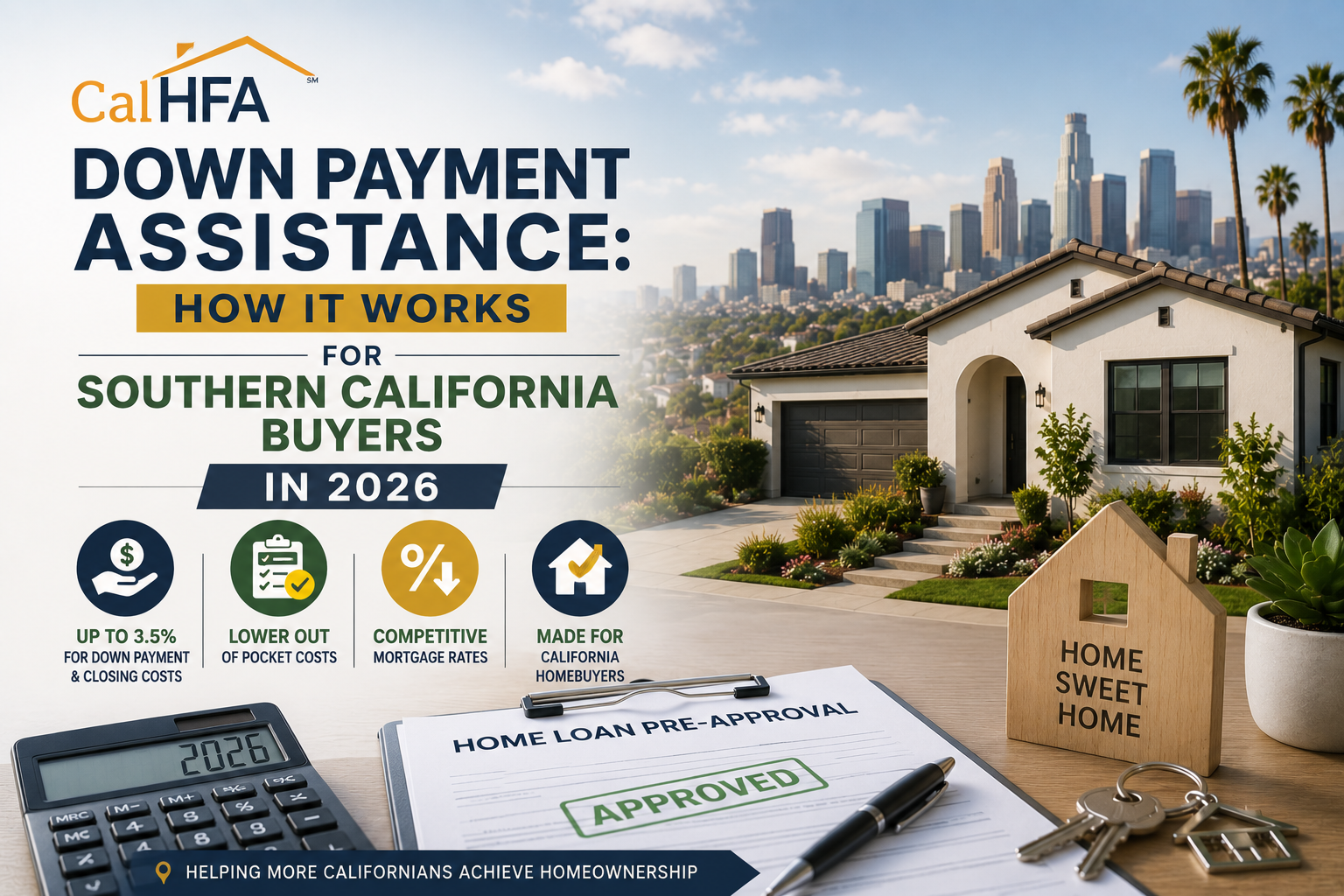

CalHFA Down Payment Assistance: How It Works for Southern California Buyers in 2026
CalHFA is one of the most searched, and most misunderstood, resources for first-time buyers in California. Some buyers think it’s free money. Others assume it’s only for very low incomes and don’t realize they qualify. Neither is quite right. Here’s how CalHFA’s programs actually work in 2026, what’s currently available, and how Southern California buyers in LA, San Bernardino, Riverside, Orange, and San Diego Counties can use them.
CalHFA MyHome Assistance Program
MyHome is CalHFA’s year-round, no-lottery down payment assistance program, and it’s the one most SoCal buyers end up using. It provides a deferred-payment second loan of up to 3%–3.5% of your home’s purchase price to help cover your down payment or closing costs.
Key things to know about MyHome:
- No monthly payments. It’s a “silent second” — the balance is deferred, not paid down monthly.
- Repaid later. You repay it when you sell, refinance, or pay off your first mortgage.
- Must pair with a CalHFA first mortgage. MyHome isn’t a standalone product — it layers on top of a CalHFA-approved FHA or conventional first mortgage.
- Available year-round. Unlike Dream For All, MyHome doesn’t run on a lottery or limited application window — it’s consistently available, subject to funding, which makes it the more reliable option for most buyers.
For a lot of SGV, IE, and broader SoCal buyers, MyHome combined with a low-down-payment FHA loan is what actually gets someone from “can’t afford the down payment” to “closing on a home.”
Dream For All: Current Status in 2026
Dream For All is CalHFA’s shared appreciation program, and it works very differently from MyHome. Instead of a small deferred loan, it can provide up to 20% of your purchase price (capped at $150,000) toward your down payment — with no monthly payments and no interest. In exchange, when you sell, refinance, or transfer the property, you repay the original assistance amount plus a share of the home’s appreciation.
Where things stand right now: The most recent Dream For All application window ran February 24 through March 16, 2026, with CalHFA making roughly $150–$200 million available for that round. That portal has since closed, and as of this writing there’s no confirmed date for the next round to open. If you’re interested in Dream For All, the right move is checking calhfa.ca.gov/dream directly for the current status, since funding rounds tend to open and close within weeks, not months.
A few things that stay consistent across rounds:
- Selection happens through a random lottery/voucher system, not first-come-first-served
- At least one borrower must be a first-generation homebuyer (generally meaning your parents don’t currently own a home in the U.S.)
- All borrowers must be first-time buyers
- You need a CalHFA-approved lender pre-approval letter before you can even enter the lottery
- If selected, you typically get 90 days to find a home and go under contract
Given how quickly these windows open and close, the buyers who move fastest are the ones already pre-approved and ready before a round opens — not the ones who start the process after hearing a window has opened.
Income Limits by County
This is the part where I’d rather be honest than give you a number that might be outdated by the time you read this. CalHFA sets income limits per county, and they’re updated annually — historically, Los Angeles, Orange, Riverside, San Bernardino, and San Diego Counties have each landed in a range roughly between $190,000 and $280,000 depending on the specific county and program, with Orange County typically running highest and Riverside/San Bernardino typically running lowest among these five.
Rather than quote a specific figure that could be a year stale, I pull the current published limit for your exact county and household situation before we go further — it takes a few minutes and gives you a definitive yes or no, rather than a rough guess based on last year’s numbers.
How to Stack DPA With FHA vs. Conventional
The right stacking strategy depends on which first mortgage you’re using:
With FHA: MyHome pairs cleanly with an FHA first mortgage at 3.5% down, and in many cases the MyHome assistance covers the entire down payment requirement — meaning your actual out-of-pocket cash need can shrink to closing costs alone, depending on your specific numbers.
With Conventional: MyHome can also pair with a CalHFA conventional first mortgage, often alongside CalHFA’s ZIP program (a separate deferred second loan specifically for closing costs), which together can cover both your down payment and closing costs on one file.
With Dream For All: This program pairs specifically with a CalHFA first mortgage product and is meant to replace most or all of your down payment need in one shot, given how large the assistance amount can be — up to 20% of purchase price.
The combined loan-to-value across your first mortgage and any CalHFA assistance is typically capped (commonly around 105%), which is one of several structural details that determines exactly how much total assistance you can actually use on a given purchase price.
Common Mistakes That Get CalHFA Deals Killed
I’ve seen good buyers lose good deals over avoidable CalHFA missteps. The most common ones:
Not using a CalHFA-approved lender from the start. Not every lender participates in CalHFA programs. Starting your pre-approval with a lender who doesn’t offer CalHFA, then trying to switch mid-transaction, wastes time you often don’t have in a competitive offer situation.
Skipping homebuyer education until the last minute. CalHFA requires completion of an approved homebuyer education course. It’s not difficult, but it needs to happen early — not the week you’re trying to close.
Assuming Dream For All is available when it isn’t. Because Dream For All gets so much press attention, some buyers build their entire purchase plan around it without checking current availability first. When the round is closed, that plan falls apart. MyHome, which is available year-round, is often the more realistic foundation to plan around, with Dream For All as a bonus if a window happens to be open.
Not accounting for the combined loan-to-value cap. Stacking too much assistance without checking the combined LTV limit can mean a file that looks great on paper doesn’t actually work once underwriting runs the real numbers.
Waiting to check income limits until late in the process. Income limits vary by county and can catch buyers off guard, especially those near the threshold. This should be confirmed at the very start, not after you’ve found a home and gone into escrow assuming eligibility.
Let’s Find the Right CalHFA Strategy for You
CalHFA programs can be a real path to homeownership across LA, San Bernardino, Riverside, Orange, and San Diego Counties — but the right combination depends on your specific income, the county you’re buying in, and what’s currently open and funded. Send me your general numbers and I’ll confirm your current CalHFA eligibility, check Dream For All’s live status, and map out exactly how much assistance you can realistically use.
Adam Tice Senior Loan Officer, Mark 1 Mortgage — Team Tice NMLS #289398 📞 626-825-2326 ✉️ adam@adamtice.com 🌐 adamtice.com

Comments are closed