
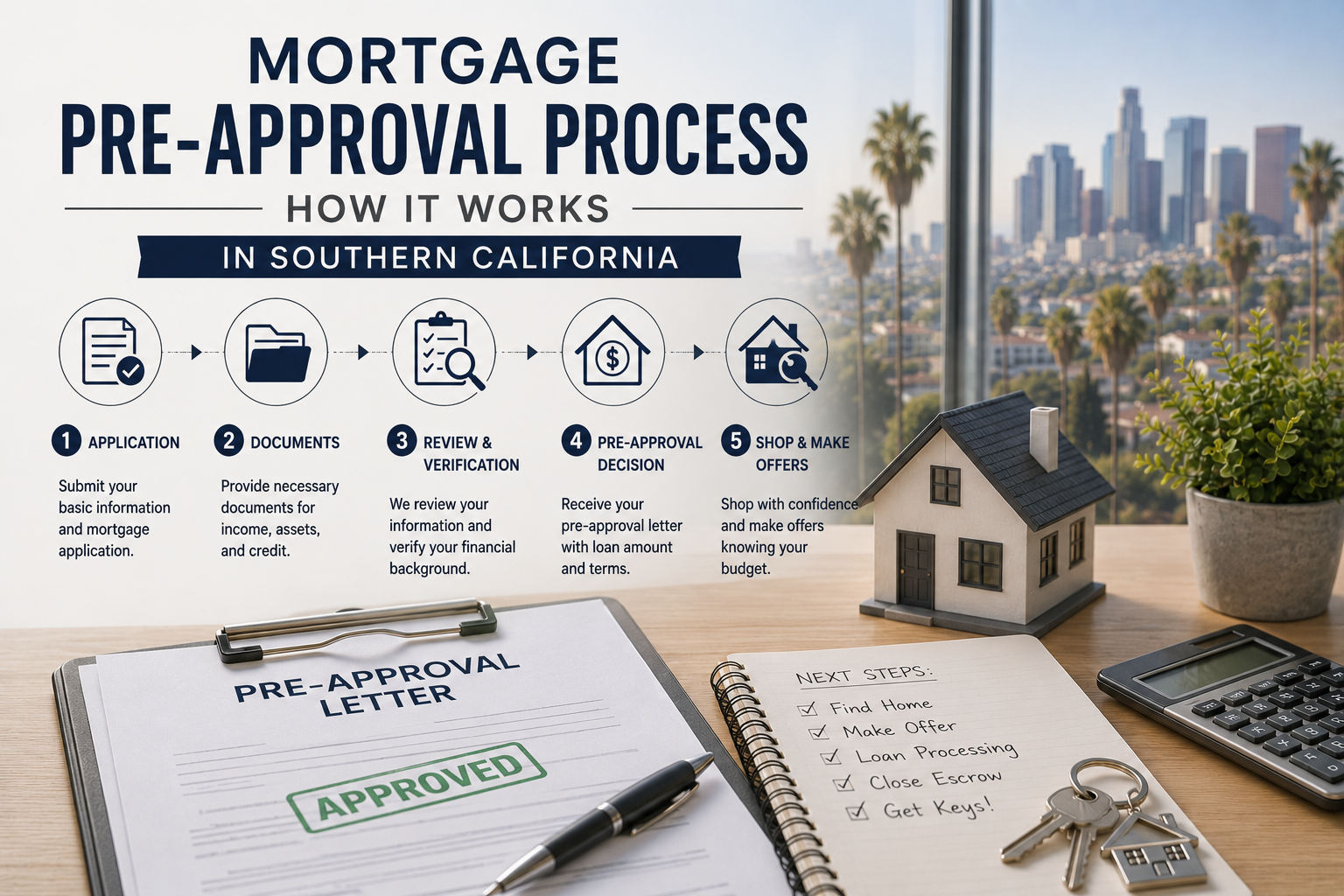

How Does the Mortgage Pre-Approval Process Work in Southern California?
Before you tour a single home, before you even call a Realtor, the first real step in buying a home in Southern California is getting pre-approved. It sounds like paperwork. It’s actually the single biggest advantage you can walk into a competitive SGV or IE market with.
Here’s exactly what pre-approval involves, what documents you’ll need, and why the buyers who get this right before house hunting consistently win the homes they want.
What Documents You Actually Need
The exact list depends on your employment situation, but here’s what covers the vast majority of buyers:
If you’re a W-2 employee:
- Last 30 days of pay stubs
- Last 2 years of W-2s
- Last 2 years of federal tax returns (in most cases)
- 2 most recent months of bank statements for all accounts you’ll use for down payment or reserves
- Photo ID
If you’re self-employed:
- Last 2 years of full federal tax returns, including all schedules
- Year-to-date profit and loss statement
- 2 most recent months of business and personal bank statements
- Business license or entity documentation, if applicable
If you’re using VA financing:
- Certificate of Eligibility (COE) — this is unique to VA loans and I can often pull this directly, saving you a step
- Same income documentation as above, based on your employment type
- DD-214 (if not on active duty)
The self-employed documentation list is longer because DSCR-style property-income underwriting doesn’t apply to owner-occupied purchases — for a home you’ll live in, lenders need to see your actual personal income trend, which takes a bit more paperwork than a straightforward W-2 file.
Pre-Qualification vs. Pre-Approval: The Difference That Matters
These two terms get used interchangeably, and that’s a problem, because they mean very different things to a seller evaluating your offer.
Pre-qualification is a quick, informal estimate based on information you self-report — no documents verified, no credit pulled in most cases. It tells you roughly what you might qualify for. It does not tell a seller anything meaningful about how solid your financing is.
Pre-approval means your income, assets, and credit have actually been reviewed and verified by an underwriter (or run through automated underwriting with supporting documents on file), and you have a real, documented approval — not just an estimate. This is what sellers and listing agents in a competitive SGV or IE market are actually looking for.
In a multiple-offer situation, a pre-qualification letter and a fully underwritten pre-approval look completely different to a seller, even though both are commonly just called “pre-approval” in casual conversation. I always make sure my clients have the real thing — a pre-approval that’s actually been through underwriting — not just a quick estimate that won’t hold up when it matters.
How Long Pre-Approval Takes and How Long It Lasts
Turnaround time: With your documents in hand, I can typically turn around a fully underwritten pre-approval in 24-48 hours. The bottleneck is almost never the lender — it’s how quickly a buyer can gather and send over their documents. Buyers who have their paperwork ready in advance are often pre-approved within a day.
How long it’s valid: Most pre-approvals are valid for 60-90 days, since they’re based on a snapshot of your income, assets, and credit at a specific point in time. If your house search runs longer than that, it’s a quick refresh — usually just updated pay stubs and bank statements — not a full restart of the process.
Why Pre-Approval Before House Hunting Matters in SGV and IE Markets
This is the part that separates buyers who win offers from buyers who lose them repeatedly:
Homes move fast. In competitive San Gabriel Valley and Inland Empire submarkets, well-priced listings can receive offers within days. If you’re starting the pre-approval process after you’ve already found a home you love, you’re often too late to compete for it.
Sellers filter out unverified buyers immediately. Listing agents in these markets have seen enough deals fall through on financing that many won’t seriously entertain an offer without a real, underwritten pre-approval attached — regardless of how strong your offer price is.
It tells you your real budget, not a guess. A lot of buyers start browsing listings based on what they assume they can afford. Pre-approval gives you your actual number, which prevents both the disappointment of falling in love with something out of reach and the mistake of underestimating what you actually qualify for.
It speeds up everything that follows. Once you’re pre-approved, moving from accepted offer to closed loan is dramatically smoother, because the heavy lifting — income and asset verification — is already done.
Getting Pre-Approved Doesn’t Have to Be Slow
I know pre-approval has a reputation for being a paperwork bottleneck. It doesn’t have to be. Send me your documents and I can turn around a fully underwritten pre-approval fast — often within a day or two — so you’re ready to make a competitive offer the moment you find the right home, not scrambling to catch up after you’ve already found it.
Adam Tice Senior Loan Officer, Mark 1 Mortgage — Team Tice NMLS #289398 📞 626-825-2326 ✉️ adam@adamtice.com 🌐 adamtice.com

Comments are closed